You are here: Urology Textbook > Kidneys > Calyceal diverticulum
Calyceal Diverticulum
Definition
A calyceal diverticulum is a cystic cavity within the kidney that does not secrete urine. It is lined with urothelium and has (or had) a ductal connection to the pyelocalyceal system (Waingankar et al., 2014). Synonym: pyelogenic cyst.
Epidemiology:
2–5:1000 in historical intravenous urography series; with modern cross-sectional imaging, they are probably detected more frequently today.
Etiology
Congenital:
Calyceal diverticula arise from embryologic maldevelopment of small branches of the ureteric bud.
Acquired:
Rarely, calyceal diverticula arise from a cortical renal abscess, a cortical cyst, or calyceal neck obstruction. Urinary stasis within a calyceal diverticulum may cause milk of calcium and nephrolithiasis.
Clinical Presentation
Many calyceal diverticula remain asymptomatic and are discovered incidentally during imaging. Possible complications include nephrolithiasis, pain, infections, or hematuria.
Diagnosis
Ultrasonography:
Ultrasonography reveals a cystic structure near a calyx, often containing echogenic material (milk of calcium) with fluid-fluid levels that vary with patient position.
CT or MRI:
CT or MRI is the diagnostic modality of choice for evaluating indeterminate cystic renal masses [fig. Calyceal diverticulum on MRI]. Delayed contrast filling of the cavity through its connection to the collecting system, with possible demonstration of calculi or milk of calcium, is diagnostic.
Retrograde pyelography:
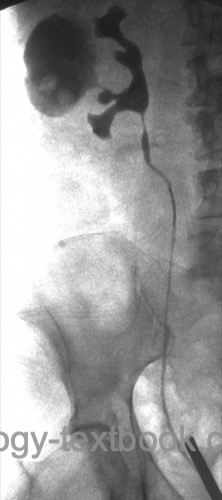
Consider retrograde pyelography during the diagnostic evaluation of hematuria or before endoscopic treatment [fig. Calyceal diverticulum on retrograde pyelography].
 |
MRI/MR Urography:
MR urography can be helpful in patients with contrast allergy, to avoid radiation exposure, or for specific diagnostic questions.
Intravenous urography:
Milk of calcium within a calyceal diverticulum is often visible on the plain KUB radiograph. Otherwise, the diverticulum may appear as a mass, and opacification on early images is not always apparent. Delayed images 1–3 h after contrast administration are helpful. CT or MR urography has now largely replaced intravenous urography for diagnostic evaluation.
Differential diagnosis:
Simple or parapelvic renal cysts, hydrocalyx due to infundibular obstruction, renal abscess, papillary necrosis, tuberculous cavities, and, rarely, cystic renal tumors.
Treatment
Asymptomatic calyceal diverticula without stone formation, infection, or symptoms generally do not require treatment. Intervention is indicated in cases of pain, recurrent infections, hematuria, significant stone burden, or an indeterminate renal mass.
Endoscopic therapy:
First, obtain percutaneous access to the diverticulum and remove any calculi. Fulguration of the diverticular mucosa promotes postoperative shrinkage. Dilate the connection between the diverticulum and collecting system and place a large-bore nephrostomy tube to ensure urinary drainage.
Flexible ureteroscopy is an option for anterior and medial calyceal diverticula that are difficult to access percutaneously.
Open or laparoscopic surgery:
Laparoscopic (robot-assisted) or open diverticulectomy is rarely necessary, for example, for large anterior diverticula, failed endourologic treatment, or an indeterminate renal mass.
| Renal malrotation | Index | Megacalycosis |
Index: 1–9 A B C D E F G H I J K L M N O P Q R S T U V W X Y Z
References
Waingankar, N., Hayek, S., Smith, A. D., and Okeke, Z. (2014). Calyceal Diverticula: A Comprehensive Review. Reviews in Urology, 16(1), 29-43. https://doi.org/https://www.ncbi.nlm.nih.gov/pmc/articles/PMC4004282/
 Deutsche Version: Kelchdivertikel
Urology-Textbook.com – Choose the Ad-Free, Professional Resource
This website is designed for physicians and medical professionals. It presents diseases of the genital organs through detailed text and images. Some content may not be suitable for children or sensitive readers. Many illustrations are available exclusively to Steady members. Are you a physician and interested in supporting this project? Join Steady to unlock full access to all images and enjoy an ad-free experience. Try it free for 7 days—no obligation.
New release: The first edition of the Urology Textbook as an e-book—ideal for offline reading and quick reference. With over 1300 pages and hundreds of illustrations, it’s the perfect companion for residents and medical students. After your 7-day trial has ended, you will receive a download link for your exclusive e-book.