You are here: Urology Textbook > Kidneys > Medullary sponge kidney
Diagnosis and Treatment of Medullary Sponge Kidney
Definition of the Medullary Sponge Kidney
A medullary sponge kidney is a congenital kidney malformation with cystic enlargement and calcification of the collecting ducts (Foster et al., 2007).
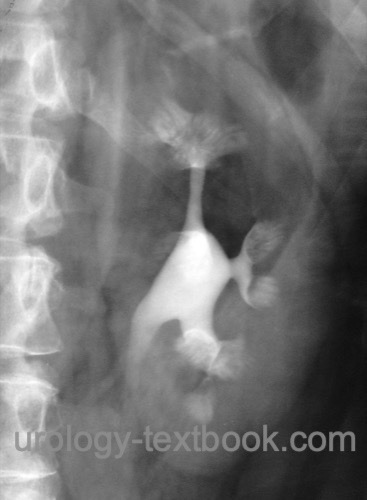 |
Epidemiology:
The prevalence is approximately 1 in 5,000. It is more common in patients with recurrent kidney stones.
Etiology:
In most sporadic cases, the exact cause of medullary sponge kidneys is unknown. In some patients, mutations can be detected in the RET (rearranged during transfection) and GDNF (glial cell line-derived neurotrophic factor) genes; the patients may also show extrarenal malformations (Ria et al., 2017).
Stone formation (calcium phosphate and calcium oxalate stones) is promoted not only by ectatic collecting ducts and urinary stasis, but also by accompanying tubular dysfunction. Frequently described abnormalities include hypocitraturia, hypercalciuria, impaired urinary concentrating ability, and incomplete distal renal tubular acidosis.
Pathology of the Medullary Sponge Kidney
Dilated intrapapillary collecting ducts and cysts arising from them measure 1–8 mm in diameter. The cut surface of the renal medulla resembles a sponge. Calcifications (70 % calcium phosphate and 30 % calcium oxalate) develop within the cysts. Medullary sponge kidney is bilateral in 75 % of cases.
Signs and Symptoms of a Medullary Sponge Kidney
- A medullary sponge kidney is often asymptomatic (incidental finding in urography or computed tomography)
- Recurrent nephrolithiasis
- Recurrent urinary tract infections
- Symptoms of chronic kidney disease (rare)
Diagnostic Workup of a Medullary Sponge Kidney
Ultrasound of the kidneys:
Hyperechoic papillae and nephrolithiasis are typical, nonspecific findings.
Computed tomography
Non-contrast CT is highly sensitive for nephrocalcinosis and urolithiasis. CT urography can demonstrate the characteristic contrast retention within ectatic collecting ducts and thereby confirm the diagnosis: linear or streaky contrast deposits adjacent to the papillae (papillary blush) on maximum intensity projection images.
Urography:
In routine clinical practice, urography has largely been replaced by CT urography. Contrast medium fills the ectatic collecting ducts and shows delayed excretion [fig. medullary sponge kidney in urography]. As the disease progresses, calcifications develop along the collecting ducts, producing a bouquet-of-flowers appearance on the full image.
Laboratory tests:
In stone-forming patients with medullary sponge kidney: urine sediment, urine culture, serum creatinine, electrolytes, calcium, and parathyroid hormone should be assessed. In the presence of abnormalities or recurrent nephrolithiasis, a metabolic evaluation is advisable; common findings include hypercalciuria, hypocitraturia, and evidence of distal renal tubular acidosis.
Differential Diagnosis of Bilateral Renal Calcifications:
- Hyperparathyroidism
- Sarcoidosis
- Distal renal tubular acidosis
- Vitamin D intoxication
- Multiple myeloma
- Urogenital tuberculosis
- Milk-alkali syndrome
Treatment of the Medullary Sponge Kidney
Treatment in medullary sponge kidney is only necessary in complications like kidney stones, urinary tract infection or renal insufficiency.
Treatment of Nephrolithiasis:
The mainstays of management are high fluid intake, dietary stone prevention, and treatment according to the same principles used for other calcium stone formers. Potassium citrate is often appropriate in patients with hypocitraturia or distal renal tubular acidosis. Thiazide diuretics may be considered in cases of hypercalciuria. Interventional stone treatment does not differ in any relevant way.
Treatment of Urinary Tract Infections:
Urinary tract infections are treated according to the clinical presentation, urine culture, and antimicrobial susceptibility pattern.
Prognosis of Medullary Sponge Kidney
The prognosis is generally favorable. In older studies, the risk of renal insufficiency in symptomatic patients was approximately 10 %; owing to improved minimally invasive stone treatment and conservative management, this figure is probably an overestimate.
| Renal cysts | Index | Acquired cystic kidney disease |
Index: 1–9 A B C D E F G H I J K L M N O P Q R S T U V W X Y Z
References
Forster, J. A.; Taylor, J.; Browning, A. J. & Biyani, C. S.
A review of the natural progression of medullary sponge kidney and a novel grading system based on intravenous urography findings.
Urol Int, 2007, 78, 264-269
 Deutsche Version: Markschwammniere
Urology-Textbook.com – Choose the Ad-Free, Professional Resource
This website is designed for physicians and medical professionals. It presents diseases of the genital organs through detailed text and images. Some content may not be suitable for children or sensitive readers. Many illustrations are available exclusively to Steady members. Are you a physician and interested in supporting this project? Join Steady to unlock full access to all images and enjoy an ad-free experience. Try it free for 7 days—no obligation.
New release: The first edition of the Urology Textbook as an e-book—ideal for offline reading and quick reference. With over 1300 pages and hundreds of illustrations, it’s the perfect companion for residents and medical students. After your 7-day trial has ended, you will receive a download link for your exclusive e-book.