You are here: Urology Textbook > Prostate > Prostate cancer > Metastases
Metastatic Prostate Cancer: Androgen deprivation therapy
- Prostate cancer: Epidemiology and etiology
- Prostate cancer: Pathology
- Prostate cancer: Signs and symptoms
- Prostate cancer: Screening
- Prostate cancer: Staging
- Prostate cancer: Treatment options
- Prostate cancer: Active surveillance
- Prostate cancer: Prostatectomy
- Prostate cancer: Radiation therapy
- Prostate cancer: Brachytherapy
- Prostate cancer: TURP and experimental treatment options
- Prostate cancer: androgen deprivation therapy of advanced prostate cancer
- Prostate cancer: Treatment of castration-resistant prostate cancer
Guidelines and review literature: (EAU Guidelines Prostate Cancer) (S3-Leitlinie Prostatakarzinom) (Walsh-Campbell Urology).
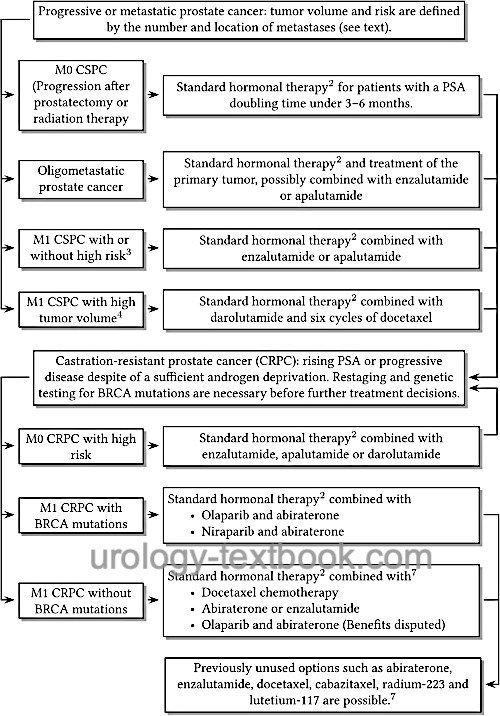
Advanced prostate cancer is classified into different disease states according to the response to androgen deprivation therapy (ADT), imaging findings, and genetic testing. Pivotal trials have further defined disease states to precisely determine the indications for modern systemic therapies:
Castration-sensitive prostate cancer:
Advanced prostate cancer with biochemical progression or proven metastases that responds to androgen deprivation therapy (ADT), known as castration-sensitive prostate cancer (CSPC). Depending on whether metastases are detected on imaging, the disease is classified as M0 CSPC or M1 CSPC. Distinguishing M0 CSPC from local recurrence after curative treatment may be difficult.
M1 CSPC with high tumor volume:
Castration-sensitive prostate cancer with at least 4 bone metastases, including at least 1 beyond the pelvis or spine, or with visceral metastases.
M1 CSPC with high risk:
Castration-sensitive prostate cancer with at least 2 of the following risk factors: Gleason score ≥ 8, at least 3 bone metastases, or visceral metastases.
Oligometastatic prostate cancer:
Castration-sensitive prostate cancer with a low metastatic burden and a maximum of 2–4 visible bone metastases, depending on the study, on conventional imaging.
Castration-resistant prostate cancer:
Advanced prostate cancer with biochemical progression or radiologic progression despite adequate androgen deprivation therapy, known as castration-resistant prostate cancer (CRPC).
M0 CRPC:
Biochemical progression of prostate cancer despite adequate androgen deprivation therapy, without metastases on imaging.
M0 CRPC with high risk:
M0 CRPC with a PSA doubling time of less than 10 months.
M1 CRPC:
Progression of prostate cancer despite adequate androgen deprivation therapy, with metastases detected on imaging.
Prognosis of Metastatic Prostate Cancer
Favorable prognostic factors include low tumor volume, absence of pain and visceral metastases, metachronous metastases after prior local treatment, a low Gleason score and PSA concentration, a good PSA response to ADT, and a long PSA doubling time; see the following table.
| Time to CRPC | Overall survival | |
| Metachronous metastases after local treatment (low tumor volume) | 26 months | 92 months |
| Metachronous metastases after local treatment (high tumor volume) | 15 months | 55 months |
| De novo diagnosis with synchronous metastases (low tumor volume) | 18 months | 52 months |
| De novo diagnosis with synchronous metastases (high tumor volume) | 12 months | 43 months |
Treatment Options
The following options are available for advanced and metastatic prostate cancer:
- Surgical androgen deprivation: bilateral subcapsular orchiectomy
- Medical androgen deprivation therapy with
- GnRH agonists: buserelin, goserelin, histrelin, leuprorelin, and triptorelin
- GnRH antagonists: degarelix and relugolix
- Nonsteroidal androgen receptor antagonists (flutamide and bicalutamide)
- Chemotherapy with docetaxel and second-line therapy with cabazitaxel
- Modern androgen receptor pathway inhibitors: abiraterone, enzalutamide, apalutamide, and darolutamide
- PARP inhibitors: olaparib, niraparib, and talazoparib
- Radiotherapy or surgical stabilization of metastases
- Intravenous radionuclides
- Osteoclast inhibition with zoledronate or denosumab
- Radiotherapy or surgical treatment of the primary tumor in oligometastatic patients
The treatment options are used sequentially or in combination according to disease progression and response [Figure androgen deprivation therapy of advanced prostate cancer]. See also pharmacokinetics and adverse effects of androgen deprivation therapy.
 |
Treatment of Castration-Sensitive Prostate Cancer
Indications for Androgen Deprivation Therapy
The German S3 guideline for prostate cancer recommends ADT for a PSA doubling time < 3 months, symptomatic local progression, proven distant metastases, as an adjunct to radiotherapy, or for extensive lymph node metastases after radical prostatectomy.
Standard Androgen Deprivation Therapy
ADT is most commonly administered with GnRH agonists, such as goserelin or leuprorelin. Because treatment initiation causes a transient increase in testosterone concentration, flutamide or bicalutamide is additionally administered orally for 2–4 weeks. GnRH agonists are available as depot injections at intervals of 1–6 months, depending on the product. Alternatives are bilateral subcapsular orchiectomy or GnRH antagonists.
Modern combination therapies:
Combining ADT with modern androgen receptor antagonists (enzalutamide, apalutamide, or darolutamide) improves progression-free and overall survival in patients with M1 CSPC. This combination is standard treatment for metastatic hormone-sensitive prostate cancer. In suitable patients with high tumor volume, docetaxel can be added as triple therapy.
Comparative trials:
GnRH agonists are oncologically equivalent to orchiectomy, whereas monotherapy with conventional androgen receptor antagonists is oncologically inferior. GnRH antagonists reduce testosterone concentrations more rapidly than GnRH agonists.
Adverse Effects
For adverse effects of ADT and their prevention, see androgen deprivation therapy.
Follow-up
Standard imaging for metastatic disease consists of CT of the abdomen and chest and bone scintigraphy. PSMA-PET detects metastases earlier, but its therapeutic consequences must be assessed individually. Repeat imaging if the disease progresses.
Laboratory tests:
Measure PSA every 3–6 months. Depending on symptoms or suspected progression, also measure complete blood count, creatinine, liver enzymes, alkaline phosphatase, and testosterone.
Intermittent Androgen Deprivation
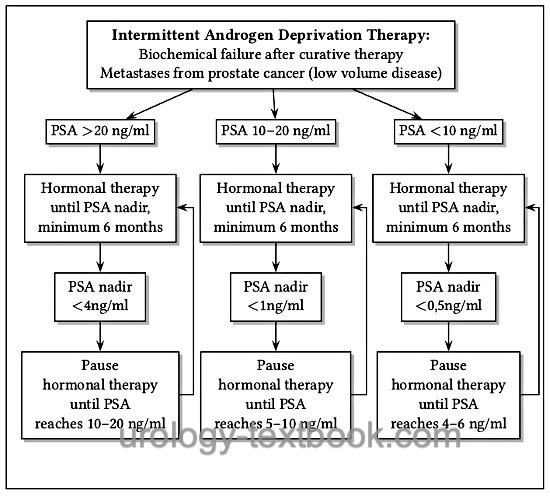
The aim of intermittent ADT is to reduce adverse effects by minimizing time on treatment; studies have demonstrated benefits for libido, erectile function, hot flashes, and general well-being. Depending on the baseline PSA concentration, ADT is continued until a defined PSA nadir is reached, followed by a treatment break until a defined PSA increase indicates another cycle of ADT [Figure intermittent androgen deprivation therapy]. Testosterone concentrations may return to normal even after several cycles of ADT (Pether and Goldenberg, 2004).
Intermittent ADT is less effective than continuous ADT (Hussain, 2012). This is even more relevant in light of the results achieved with modern ADT-based doublet therapy. Intermittent ADT remains an option for patients with low tumor volume and slowly progressive disease who place a high value on reducing treatment-related adverse effects.
 |
Local Therapy for Metastatic Prostate Cancer
In selected oligometastatic patients, radiotherapy to the primary tumor, in addition to ADT and, if necessary, radiotherapy to individual metastases, can improve survival (Burdett et al., 2019). An oncologic benefit of radical prostatectomy in oligometastatic patients has not been sufficiently established, but it remains an option in selected cases (Leyh et al., 2017), particularly in patients with urinary retention or local symptoms.
Chemotherapy for M1 CSPC with High Tumor Volume
Combining ADT with docetaxel improves overall survival in suitable patients with M1 CSPC, particularly in those with high tumor volume. Start chemotherapy within the first months after beginning ADT.
In the CHAARTED trial, 790 men were randomized to ADT with GnRH antagonists or agonists alone or to ADT plus 6 cycles of docetaxel. In patients with high tumor volume, adding docetaxel improved median overall survival by 17 months (49 versus 32 months). High tumor volume was defined as at least 4 bone metastases, including at least 1 beyond the pelvis or spine, or visceral metastases (Sweeney et al., 2015). In the STAMPEDE trial, 2962 men were randomized to ADT alone, ADT plus docetaxel, ADT plus zoledronic acid, or ADT plus both docetaxel and zoledronic acid. ADT plus docetaxel prolonged survival by 10 months (81 versus 71 months), whereas zoledronic acid did not improve survival (James et al., 2016).
Triple Therapy for M1 CSPC with High Tumor Volume
In randomized trials, triple therapy with ADT, docetaxel, and either abiraterone/prednisolone or darolutamide improved overall survival and delayed disease progression. In PEACE-1, ADT plus abiraterone and docetaxel improved overall survival (HR 0.75) and progression-free survival (HR 0.50) compared with ADT plus docetaxel (Fizazi et al., 2022). In ARASENS, ADT plus darolutamide and docetaxel improved overall survival (HR 0.68) and progression-free survival compared with ADT plus docetaxel (Smith et al., 2022). Triple therapy with ADT, darolutamide, and docetaxel has been approved in the United States since 2022 and in Europe since 2023 and is a standard option for patients with high tumor volume.
Enzalutamide Combined with ADT for M1 CSPC
The randomized ENZAMET trial demonstrated that ADT combined with enzalutamide improves overall survival and delays disease progression (Davis et al., 2019). Benefits were observed across risk groups. The ARCHES trial confirmed these findings (Armstrong et al., 2021). Enzalutamide has been approved for hormone-sensitive prostate cancer across risk groups since 2021.
Apalutamide Combined with ADT for M1 CSPC
The randomized TITAN trial demonstrated that ADT combined with apalutamide improves overall survival and delays disease progression (Chi et al., 2019). Benefits were observed across risk groups. Apalutamide has been approved for hormone-sensitive prostate cancer across risk groups since 2020.
Darolutamide Combined with ADT for M1 CSPC
The randomized ARANOTE trial demonstrated that ADT combined with darolutamide delays disease progression and showed a trend toward improved overall survival (Saad et al., 2024). Benefits were observed across risk groups. Darolutamide has been approved for hormone-sensitive prostate cancer across risk groups since 2025.
Abiraterone Combined with ADT for High-Risk M1 CSPC
Approval of abiraterone was extended on the basis of STAMPEDE (James et al., 2017) and LATITUDE (Fizazi et al., 2017). Adding abiraterone 1000 mg/d plus prednisolone 5 mg/d to ADT improved survival, prolonged progression-free survival, and delayed the start of chemotherapy. Because abiraterone has an important role in castration-resistant disease, including in combination with olaparib, its early use in CSPC should be considered cautiously.
PARP Inhibitors for M1 CSPC with BRCA1/2 Mutations
In patients with M1 CSPC and a pathogenic HRR mutation, niraparib/abiraterone plus prednisone can be prescribed early in addition to ADT. In the randomized phase III AMPLITUDE trial, niraparib combined with abiraterone and prednisone improved radiographic progression-free survival in HRR-altered metastatic CSPC, particularly in patients with BRCA1/2 mutations (Attard et al., 2025). Despite the substantial radiographic progression-free survival benefit in BRCA1/2-altered disease, early use of a PARP inhibitor plus abiraterone in M1 CSPC should be considered critically: a significant overall survival benefit has not yet been conclusively established, highly effective alternatives are available, and treatment causes relevant hematologic and cardiovascular toxicity.
| Prostate cancer: TURP, HIFU | Index | Castration resistant prostate cancer |
Index: 1–9 A B C D E F G H I J K L M N O P Q R S T U V W X Y Z
References
EAU Guidelines EAU - EANM - ESTRO - ESUR - SIOG Guidelines on Prostate Cancer, https://uroweb.org/guidelines/prostate-cancer/.
Fizazi, K.; Tran, N.; Fein, L.; Matsubara, N.;
Rodriguez-Antolin, A.; Alekseev, B. Y.; Özgüroğlu, M.; Ye, D.; Feyerabend,
S.; Protheroe, A.; De Porre, P.; Kheoh, T.; Park, Y. C.; Todd, M. B.; Chi,
K. N. & Investigators, L.
Abiraterone plus Prednisone in
Metastatic, Castration-Sensitive Prostate Cancer.
The New England
journal of medicine, 2017, 377, 352-360
I. D. Davis et al. “Enzalutamide with Standard First-Line Therapy in Metastatic Prostate Cancer.,” The New England journal of medicine, vol. 381, no. 2, pp. 121–131, 2019.
Halabi u.a. 2003 HALABI, S. ; SMALL, E. J. ;
KANTOFF, et a.:
Prognostic model for predicting survival in men with
hormone-refractory metastatic prostate cancer.
In: J Clin Oncol
21 (2003), Nr. 7, S. 1232–7
Hussain, M.
Intermittent (IAD) versus continuous
androgen deprivation (CAD) in hormone sensitive metastatic prostate cancer
(HSM1PC) patients (pts): Results of S9346 (INT-0162), an international
phase III trial.
J Clin Oncol, 2012, 30 (suppl;
abstr 4).
James, N. D.; Sydes, M. R.; Clarke, N. W.; Mason, M.
D.; Dearnaley, D. P.; Spears, M. R.; Ritchie, A. W. S.; Parker, C. C.;
Russell, J. M.; Attard, G.; de Bono, J.; Cross, W.; Jones, R. J.;
Thalmann, G.; Amos, C.; Matheson, D.; Millman, R.; Alzouebi, M.; Beesley,
S.; Birtle, A. J.; Brock, S.; Cathomas, R.; Chakraborti, P.; Chowdhury,
S.; Cook, A.; Elliott, T.; Gale, J.; Gibbs, S.; Graham, J. D.;
Hetherington, J.; Hughes, R.; Laing, R.; McKinna, F.; McLaren, D. B.;
O'Sullivan, J. M.; Parikh, O.; Peedell, C.; Protheroe, A.; Robinson, A.
J.; Srihari, N.; Srinivasan, R.; Staffurth, J.; Sundar, S.; Tolan, S.;
Tsang, D.; Wagstaff, J.; Parmar, M. K. B. & , S. T. A. M. P. E. D. E.
Addition
of docetaxel, zoledronic acid, or both to first-line long-term hormone
therapy in prostate cancer (STAMPEDE): survival results from an adaptive,
multiarm, multistage, platform randomised controlled trial.
Lancet 2016, 387,
1163-1177.
James, N. D.; de Bono, J. S.; Spears, M. R.;
Clarke, N. W.; Mason, M. D.; Dearnaley, D. P.; Ritchie, A. W. S.; Amos, C.
L.; Gilson, C.; Jones, R. J.; Matheson, D.; Millman, R.; Attard, G.;
Chowdhury, S.; Cross, W. R.; Gillessen, S.; Parker, C. C.; Russell, J. M.;
Berthold, D. R.; Brawley, C.; Adab, F.; Aung, S.; Birtle, A. J.; Bowen,
J.; Brock, S.; Chakraborti, P.; Ferguson, C.; Gale, J.; Gray, E.;
Hingorani, M.; Hoskin, P. J.; Lester, J. F.; Malik, Z. I.; McKinna, F.;
McPhail, N.; Money-Kyrle, J.; O'Sullivan, J.; Parikh, O.; Protheroe, A.;
Robinson, A.; Srihari, N. N.; Thomas, C.; Wagstaff, J.; Wylie, J.; Zarkar,
A.; Parmar, M. K. B.; Sydes, M. R. & STAMPEDE Investigators
Abiraterone
for Prostate Cancer Not Previously Treated with Hormone Therapy.
The
New England journal of medicine, 2017, 377, 338-351.
Loblaw u.a. 2004 LOBLAW, D. A. ; MENDELSON,
D. S. ; TALCOTT, J. A. ; VIRGO, K. S. ;
SOMERFIELD, M. R. ; BEN-JOSEF, E. ; MIDDLETON,
R. ; PORTERFIELD, H. ; SHARP, S. A. ; SMITH,
T. J. ; TAPLIN, M. E. ; VOGELZANG, N. J. ; WADE,
Jr. ; BENNETT, C. L. ; SCHER, H. I.:
American Society of Clinical Oncology recommendations for the initial
hormonal management of androgen-sensitive metastatic, recurrent, or
progressive prostate cancer.
In: J Clin Oncol
22 (2004), Nr. 14, S. 2927–41
Mottet, Nicolas; Damme, Jean Van; Loulidi, Salim;
Russel, Christoph; Leitenberger, Armin; Wolff, Johannes M & the TAP22
Investigators Group
Intermittent hormonal therapy in the treatment of
metastatic prostate cancer: a randomized trial.
BJU Int, 2012.
M. Pether and S. L. Goldenberg.
Intermittent androgen suppression.
BJU Int, 93 (3): 258–261, Feb 2004.
Pound u.a. 1999 POUND, C. R. ; PARTIN, A. W. ;
EISENBERGER, M. A. ; CHAN, D. W. ; PEARSON,
J. D. ; WALSH, P. C.:
Natural history of progression after PSA elevation following radical
prostatectomy.
In: Jama
281 (1999), Nr. 17, S. 1591–7
Leitlinienprogramm Onkologie (DGU, Deutsche Krebsgesellschaft, Deutsche Krebshilfe): Interdisziplinäre Leitlinie der Qualität S3 zur Früherkennung, Diagnose und Therapie der verschiedenen Stadien des Prostatakarzinoms https://www.leitlinienprogramm-onkologie.de/leitlinien/prostatakarzinom/
Wein, A. J.; Kavoussi, L. R.; Partin, A. P. & Peters, C. A.
Campbell-Walsh Urology
. Elsevier, 2015. ISBN 978-1455775675.
Saad F, Vjaters E, Shore N, Olmos D, Xing N, Pereira de Santana Gomes AJ, Cesar de Andrade Mota A, Salman P, Jievaltas M, Ulys A, Jakubovskis M, Kopyltsov E, Han W, Nevalaita L, Testa I, Le Berre MA, Kuss I, Haresh KP; ARANOTE Study Investigators. Darolutamide in Combination With Androgen-Deprivation Therapy in Patients With Metastatic Hormone-Sensitive Prostate Cancer From the Phase III ARANOTE Trial. J Clin Oncol. 2024 Dec 20;42(36):4271-4281. doi: 10.1200/JCO-24-01798.
Salonen, A. J.; Taari, K.; Ala-Opas, M.; Viitanen, J.;
Lundstedt, S.; Tammela, T. L. J. & Group, F.
The FinnProstate Study
VII: intermittent versus continuous androgen deprivation in patients with
advanced prostate cancer.
J Urol, 2012, 187,
2074-2081.
Smaletz u.a. 2002 SMALETZ, O. ; SCHER, H. I. ;
SMALL, E. J. ; VERBEL, D. A. ; MCMILLAN, A. ;
REGAN, K. ; KELLY, W. K. ; KATTAN, M. W.:
Nomogram for overall survival of patients with progressive metastatic
prostate cancer after castration.
In: J Clin Oncol
20 (2002), Nr. 19, S. 3972–82
C. J. Sweeney et al., “Chemohormonal Therapy in Metastatic Hormone-Sensitive Prostate Cancer.,” N Engl J Med, vol. 373, no. 8, pp. 737–746, 2015.
 Deutsche Version: Diagnose und Therapie des metastasierten hormonsensiblen Prostatakarzinoms
Urology-Textbook.com – Choose the Ad-Free, Professional Resource
This website is designed for physicians and medical professionals. It presents diseases of the genital organs through detailed text and images. Some content may not be suitable for children or sensitive readers. Many illustrations are available exclusively to Steady members. Are you a physician and interested in supporting this project? Join Steady to unlock full access to all images and enjoy an ad-free experience. Try it free for 7 days—no obligation.
New release: The first edition of the Urology Textbook as an e-book—ideal for offline reading and quick reference. With over 1300 pages and hundreds of illustrations, it’s the perfect companion for residents and medical students. After your 7-day trial has ended, you will receive a download link for your exclusive e-book.