You are here: Urology Textbook > Kidneys > Horseshoe kidney
Horseshoe Kidney
Definition of a Horseshoe Kidney
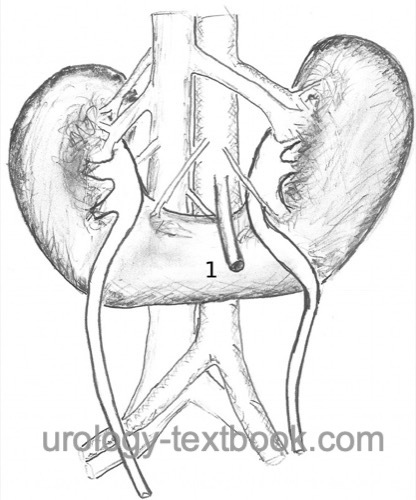
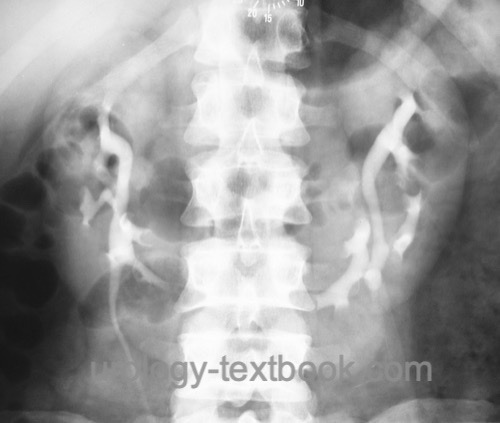
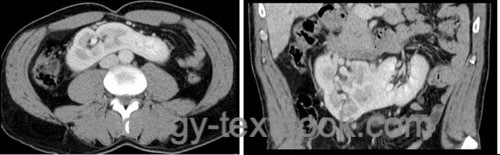
A horseshoe kidney is the fusion of the lower poles of both kidneys ventral of the aorta, the fusion is called isthmus of the horseshoe kidney. It consists of connective tissue or renal parenchyma [see the following figures]. Review literature: (Kölln et al., 1972) (Stein and Desai, 2007).
 |
 |
 |
Epidemiology of a Horseshoe Kidney
Incidence 1:700. Male:female = 2:1.
Etiology of a Horseshoe Kidney
The fusion of the lower poles takes place before the rotation and the ascension of the kidneys, causing a ventral orientation of the renal pelvis and dorsal position of the calyceal system. The inferior mesenteric artery inhibits the ascension of the kidney. The vascular supply of the horseshoe kidney derives from the iliac vessels and the distal aorta. Due to the abnormal vasculature, horseshoe kidneys may develop an extrinsic ureteropelvic obstruction with hydronephrosis.
Signs and Symptoms of a Horseshoe Kidney
60% of patients with a horseshoe kidney do not develop any symptoms. Otherwise, hydronephrosis, nephrolithiasis, and infections are the most often complaints.
Malformations:
A horseshoe kidney is associated with other malformations (neural tube defect, heart defects, and musculoskeletal system). 5–10% of patients with horseshoe kidneys have additional urogenital anomalies. A horseshoe kidney is associated with Turner syndrome and trisomy 18.
Oncogenic risk:
The risk for Wilms tumor is doubled. Increased risk for the rare renal carcinoid in horseshoe kidneys.
Diagnosis
Typical ultrasound findings are low-lying kidneys, fusion of the lower poles by an isthmus (ventral to the aorta), and ventrally oriented renal pelves. If the anatomy is unclear, before interventional or surgical treatment, or when complications are suspected, additional cross-sectional imaging (CT or MRI) is advisable.
Treatment of a Horseshoe Kidney
Nephrolithiasis:
All techniques of stone therapy can be used: extracorporeal shock wave lithotripsy (ESWL), ureteroscopy or percutaneous nephrolithotomy.
Hydronephrosis:
Depending on the renal function, pyeloplasty or heminephrectomy is the treatment of choice.
Tumors of the horseshoe kidney:
Treatment depends on tumor size, age of the patients, and suspected histology. Pay attention to the pathological vascular supply of the horseshoe kidney in treatment decisions.
| Kidney diseases | Index | Kidney malrotations |
Index: 1–9 A B C D E F G H I J K L M N O P Q R S T U V W X Y Z
References
Kölln, C. P.; Boatman, D. L.; Schmidt, J. D. & Flocks, R. H. Horseshoe kidney: a review of 105 patients.J Urol, 1972, 107, 203-204.
Stein, R. J. & Desai, M. M. Management of urolithiasis in the congenitally abnormal kidney (horseshoe and ectopic).
Curr Opin Urol, 2007, 17, 125-131.
 Deutsche Version: Hufeisenniere
Urology-Textbook.com – Choose the Ad-Free, Professional Resource
This website is designed for physicians and medical professionals. It presents diseases of the genital organs through detailed text and images. Some content may not be suitable for children or sensitive readers. Many illustrations are available exclusively to Steady members. Are you a physician and interested in supporting this project? Join Steady to unlock full access to all images and enjoy an ad-free experience. Try it free for 7 days—no obligation.
New release: The first edition of the Urology Textbook as an e-book—ideal for offline reading and quick reference. With over 1300 pages and hundreds of illustrations, it’s the perfect companion for residents and medical students. After your 7-day trial has ended, you will receive a download link for your exclusive e-book.