You are here: Urology Textbook > Anatomy > Kidney > Glomerular filtration rate
Physiology of the kidney (4/7): Glomerular filtration rate
- Anatomy of the kidney (1/7): Gross anatomy
- Anatomy of the kidney (2/7): Histology of the glomerulus and nephron
- Anatomy of the kidney (3/7): Histology of renal tubules
- Anatomy of the kidney (4/7): Physiology of the glomerular filtration rate
- Anatomy of the kidney (5/7): Physiology of the tubular reabsorption
- Anatomy of the kidney (6/7): Physiology of the renin-angiotensin-aldosterone system
- Anatomy of the kidney (7/7): Physiology of erythropoetin, endothelins and vitamin D
Review literature: (Benninghoff, 1993) (Schmidt und Thews, 1995).
Glomerular Filtration Rate
In the glomerulus, the primary urine is filtered from the blood, which flows through the capillaries of the glomerulus. With the exception of proteins over a molecular mass of 10 kDa, all components of the plasma are filtered into the primary urine. Subsequently, the active and passive reabsorption of important substances in the renal tubules from the primary urine is of elementary importance (see tubular reabsorption .
The renal blood flow is approximately 20% of the cardiac output at rest (1–1.2 l/min). About 10% of renal blood flow is filtered and make up the primary urine. The filtration speed of the primary urine is called glomerular filtration rate (GFR) and is approximately 120 ml/min. The following variables increase the GFR: increased hydraulic pressure in the glomerular capillaries and the area (amount) of glomerular capillaries. The following variables decrease the GFR: increased hydraulic pressure in the Bowman capsule, increased colloid osmotic pressure in the glomerular capillaries, decreased permeability of the glomerular capillaries.
Regulation of Glomerular Filtration Rate
The hydrostatic pressure in the glomerular capillaries is directly dependent on the arterial blood pressure and is the decisive factor for the normal regulation of the glomerular filtration rate (GFR). Several kidney mechanisms provide for a constant GFR over wide ranges of physiological blood pressure variations.
Autonomic vasoreactive (myogenic) reflex:
Blood pressure fluctuations are compensated by vasoconstriction and vasodilation of the afferent arteriole.
Tubuloglomerular feedback:
Increased hydrostatic pressure in the glomerulus leads to glomerular hyperfiltration and increased fluid load on the tubule. This is registered at the macula densa of the distal tubule and leads to vasoconstriction of the afferent arteriole using the transmitters ATP and adenosine.
Renin-angiotensin system:
Low blood pressure and decreased kidney perfusion result in the release of renin and activation of angiotensin II via intermediate steps [see Renin-Angiotensin-System]. Angiotensin II leads to vasoconstriction of the efferent arteriole and increases the filtration pressure in the glomerulus.
Renal Clearance
The glomerular filtration rate cannot be measured directly. For approximation, the elimination of a substance is measured, which is
- completely filtered with the primary urine
- not reabsorbed in the renal tubules
- not secreted in the renal tubules
Definition of the Renal Clearance (Cl)
Renal clearance is the virtual plasma volume per minute, from which a substance is completely eliminated. If a substance is chosen, which is not secreted or reabsorbed in the renal tubules, the measured clearance corresponds to the glomerular filtration rate (GFR).
Calculation of the creatinine clearance
The concentration of creatinine (UKrea in mg/dl) and the urine volume (Uvol in ml) of a 24-hour urine collection is measured. In addition, the serum concentration of creatinine (PKrea in mg/dl) is measured. The time span of the urine collection has to calculated in minutes (usually 24 h = 1440 min). The creatinine clearance (ClKrea) is calculated with the following formula:
Creatinine clearance (ml/min) = (Ucrea × Uvol)/(Screa × 1440)
An estimation of the creatinine clearance can be obtained using the formula of Cockcroft and Gault using the serum concentration of creatinine (SKrea in mg/dl), gender (factor F=72 for men and F=85 for women), weight (kgKG in kg) and age (Alter in years):
GFR = -(140-age)×weight / (F× Screa)
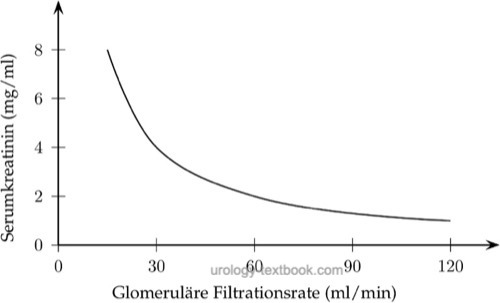
Substances with exclusive glomerular filtration (without tubular secretion or reabsorption) as creatinine have serum concentrations in direct dependence of the glomerular filtration rate (GFR). A halving of GFR leads to a doubling of the serum creatinine concentration. This means, that a reduction of the GFR by 75% leads to a significant fourfold increase of the serum creatinine concentration. Further (only slight) reductions in GFR lead to dramatic increases creatinine concentrations [fig. creatinine concentration and GFR].
 |
| Kidney, distal nephron | Index | Kidney, reabsorption |
Index: 1–9 A B C D E F G H I J K L M N O P Q R S T U V W X Y Z
References
Benninghoff, A. (1993): Makroskopische Anatomie, Embryologie und Histologie des Menschen. 15. Auflage. München; Wien; Baltimore: Urban & Schwarzenberg.
Schmidt, R. F. & Thews, G. T. (ed.) Physiologie des Menschen
26. Auflage
Berlin; Heidelberg; New York: Springer, 1995
 Deutsche Version: Physiologie der Nieren: Glomeruläre Filtrationsrate und Kreatinin-Clearance.
Urology-Textbook.com – Choose the Ad-Free, Professional Resource
This website is designed for physicians and medical professionals. It presents diseases of the genital organs through detailed text and images. Some content may not be suitable for children or sensitive readers. Many illustrations are available exclusively to Steady members. Are you a physician and interested in supporting this project? Join Steady to unlock full access to all images and enjoy an ad-free experience. Try it free for 7 days—no obligation.
New release: The first edition of the Urology Textbook as an e-book—ideal for offline reading and quick reference. With over 1300 pages and hundreds of illustrations, it’s the perfect companion for residents and medical students. After your 7-day trial has ended, you will receive a download link for your exclusive e-book.