You are here: Urology Textbook > Penis > Sexually transmitted diseases > Chancroid
Chancroid: Diagnosis and Treatment of Soft Chancre
Definition of Chancroid
Chancroid is a sexually transmitted disease caused by Haemophilus ducreyi, leading to genital ulcers (ulcus molle, soft chancre) and painful lymphadenopathy (bubo).
Epidemiology of Chancroid
Mainly in tropical countries, the prevalence has been decreasing for two decades. Only sporadic occurrence in Europe and North America.
Etiology
Pathogen of Chancroid:
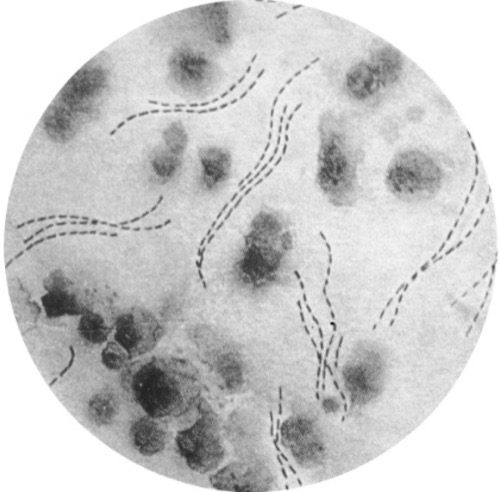
Haemophilus ducreyi: immobile gram-negative bacteria, oval cocci arranged in chains.
Signs and Symptoms
Genital Ulcer:
Short incubation period of 3–7 days. Chancroid starts with erythematous papules, which rupture and lead to one or more purulent genital ulcers (ulcus molle). The ulcers are very painful and 2–20 mm in diameter. Genital lymphedema is possible.
Lymphadenopathy
Painful tender groin lumps (bubo) are typical for chancroid in combination with a painful genital ulcer. Untreated chancroid leads to suppurative lymphadenopathy (abscess formation and drainage over the inguinal skin).
Diagnosis of Chancroid
NAAT Swab Test:
Nucleic acid amplification technique (NAAT) has the highest sensitivity for diagnosing H. ducreyi from ulcer exudate.
Culture:
Diagnosis can be achieved with a selective culture, but fast transportation to the lab or bedside inoculation of culture plate is necessary. Culture is particular important in cases of therapeutic failure.
Microscopy:
Microscopic detection of pathogens from the depths of the genital ulcer is possible but with low specificity and sensitivity. The Gram stain shows gram-negative cocci in chain formation [fig. Microscopy: Haemophilus ducreyi].
 |
Further laboratory tests:
Test for syphilis and Herpes simplex for differential diagnosis. Test for HIV and other STDs. Sex partner examination.
Treatment of Chancroid
Recommended antibiotic treatment of Chancroid:
- First choice: azithromycin 1 g p.o. once or ceftriaxone 250 mg IM once
- Alternatives: ciprofloxacin 500 mg p.o. 1-0-1 for three days or erythromycin 500 mg p.o. 1-1-1-1 for seven days
- Treat sex partners should be treated even without symptoms or diagnosis.
- Fluctuating lymph nodes and abscess formations: extend antibiotic treatment and needle aspiration or incision and drainage depending on severity.
Resistance to antibiotic treatment is possible. Symptomatic improvement is expected within three days, with objective ulcer healing within seven days of antibiotic therapy.
| Lymphogranuloma venereum | Index | Granuloma inguinale |
Index: 1–9 A B C D E F G H I J K L M N O P Q R S T U V W X Y Z
References
Center for Disease Control and Prevention: “Sexually Transmitted Infections (STI) Treatment Guidelines,” 2021. [Online]. Available: https://www.cdc.gov/std/treatment-guidelines/STI-Guidelines-2021.pdf
IUSTI, “European guideline for the management of chancroid,” 2017. [Online]. Available: https://iusti.org/wp-content/uploads/2019/12/chancroid.pdf.
 Deutsche Version: Ulcus molle (weicher Schanker).
Urology-Textbook.com – Choose the Ad-Free, Professional Resource
This website is designed for physicians and medical professionals. It presents diseases of the genital organs through detailed text and images. Some content may not be suitable for children or sensitive readers. Many illustrations are available exclusively to Steady members. Are you a physician and interested in supporting this project? Join Steady to unlock full access to all images and enjoy an ad-free experience. Try it free for 7 days—no obligation.
New release: The first edition of the Urology Textbook as an e-book—ideal for offline reading and quick reference. With over 1300 pages and hundreds of illustrations, it’s the perfect companion for residents and medical students. After your 7-day trial has ended, you will receive a download link for your exclusive e-book.