You are here: Urology Textbook > Surgery (procedures) > Simple suprapubic prostatectomy
Suprapubic Simple Prostatectomy
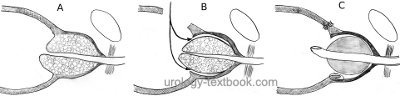 |
Indications for Suprapubic Simple Prostatectomy
The most frequent indications for surgical treatment of benign prostatic hyperplasia are moderate to severe BPH symptoms, which cannot be alleviated with BPH medication (see section medical treatment of BPH). Other indications for surgical treatment include recurrent urinary retention, bladder stones, recurrent urinary tract infection, recurrent hematuria and postrenal kidney failure due to insufficient bladder emptying.
The surgical technique of transvesical simple prostatectomy [fig. principle of suprapubic prostatectomy] is ideal for very large adenoma (>75 ml) with a significant middle lobe, bladder diverticula which require surgical correction, large bladder stones, inguinal hernia (to be corrected together with prostatectomy), complex urethral diseases (e.g., after hypospadias operations) and contraindications for lithotomy position.
Contraindications to Suprapubic Prostatectomy
Prostate cancer, low life expectancy, coagulation disorders, untreated urinary tract infection.
Surgical Technique of Suprapubic Simple Prostatectomy
Preoperative Patient Preparation
- Exclusion or treatment of a urinary tract infection
- Perioperative antibiotic prophylaxis
- General anesthesia or spinal anesthesia
- Supine position with slight hyperextension of the lumbar spine
- Disinfection and draping
- Fill the bladder with 200–300 ml saline
Surgical Approach:
- Lower midline incision or Pfannenstiel incision
- Cut the linea alba
- After blunt dissection of the retropubic space, insert a wound retractor
- Vertical cystostomy, which is secured with sutures to prevent further tearing
- Remove bladder stones or resect bladder diverticula, if present
Dissection of the Prostatic Adenoma:
- Circular incision of the bladder neck with the electric scalpel after identification of the ureteral orifices
- The plane between prostatic adenoma and peripheral prostatic tissue ("prostatic capsule") is developed with scissor dissection
- Blunt finger dissection completes the mobilization of the prostatic adenoma. The apical dissection should avoid excessive traction of the urethra (and the urinary sphincter).
Hemostasis after Suprapubic Prostatectomy:
- The bladder mucosa is readvanced into the prostatic fossa by two figure-of-eight sutures at the 4 o'clock and 8 o'clock position (do not incorporate the ureteric orifices).
- A running suture of the bladder neck is done between the figure-of-eight sutures.
- Major bleeding should be stopped now, other discrete bleeding sites are controlled with electrocautery or suture ligatures.
- An irrigation catheter (20–22 CH) is placed into the prostatic fossa and blocked with 50–100 ml, depending on the size of the prostatic adenoma.
- If sufficient hemostasis after blocking of the catheter is not achieved, the bladder neck can be narrowed to tamponade the prostatic fossa with fast absorbable sutures (purse-string suture). The bladder neck can be opened after 8 days using the catheter ballon or the spontaneous resolution of the sutures have to be awaited.
Wound Closure:
- Optional: insert a suprapubic tube
- Two-layer closure of the cystotomy
- Irrigation of the wound cavity
- Insert a wound drainage (e.g., closed gravity system)
- Separate closure of fascia, subcutis and cutis
Postoperative Management after Suprapubic Prostatectomy
- After surgery: continuous irrigation of the bladder, pain management via patient-controlled analgesia, exercises to prevent thrombosis and pneumonia. Excessive bleeding may be controlled by increasing the catheter block or by gentle catheter traction. If not successful, proceed with transurethral coagulation to control bleeding.
- First day: reduce or stop the continuous irrigation, patient ambulation.
- Second day: reduction of the catheter balloon to 30 ml. Removal of wound drainage (if <75 ml/24 h drainage).
- Third to fifth day: removal of the irrigation catheter, cystography may be performed to ensure a watertight closure of the bladder.
Complications of Suprapubic Prostatectomy
- Bleeding: re-exploration (transurethral coagulation, evacuation of bladder tamponade) and/or blood transfusion are seldom necessary
- Rarely urinary incontinence
- Rarely erectile dysfunction
- Often retrograde ejaculation (80–90%)
- Urinary tract infections
- Bladder neck sclerosis, urethral stricture
- Wound infection
- Urinoma
- Thrombosis, pulmonary embolism
| Greenlight laser | Index | Abbreviations |
Index: 1–9 A B C D E F G H I J K L M N O P Q R S T U V W X Y Z
References
 Deutsche Version: transvesikale Adenomektomie